


 |
 |
 |
 |
|
 |
 |
ABATE of Florida Inc SOUTHWEST CHAPTER
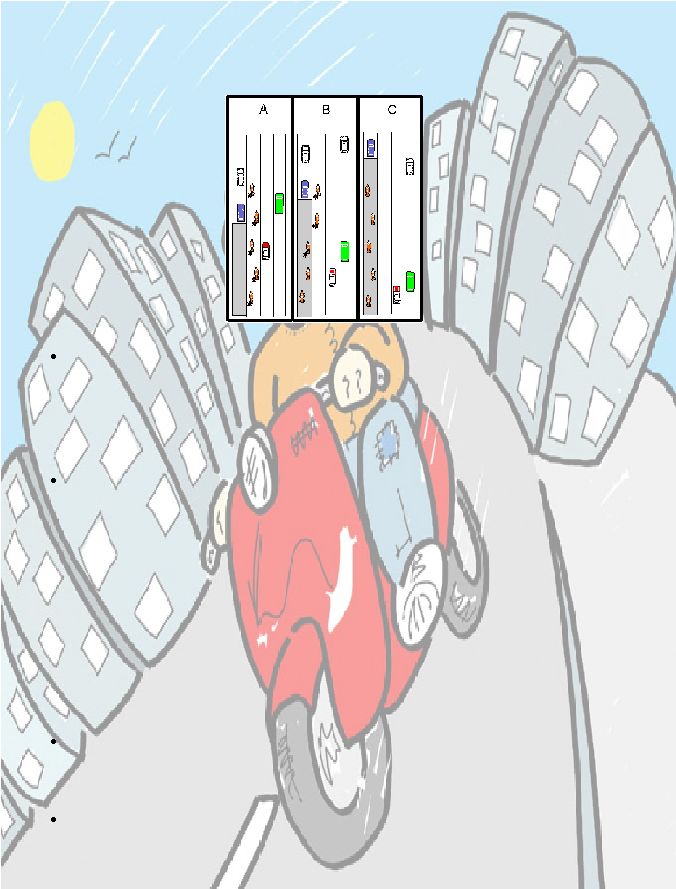
passed. If not, then a last-to-front maneuver is called for (the lead bike will slow the group down
upon hearing that the drag bike has obtained the lane.) The choice is made by the lead bike.
When riding as a group, lane changes into a lane that is moving faster than you are should be
done back to front - the drag bike obtaining the lane, and the others coming over only after the
bike behind them has moved, and only if they individually confirm it is safe to do so. Pretty
standard stuff, I'll grant you, other than the last to first moves. This is done because with the drag
bike in position and maintaining his original speed, the 'hole' in the target lane gets larger in front
of him. If you wait until everyone can move into it at once, that hole is awfully inviting to impatient
automobile drivers too.
One lesson that the MSF class teaches that I think needs to be clarified better is their admonition
to always stop with one foot on the ground. Fine, if it is a small bike, but a touring bike should be
stopped placing both feet on the ground at the same time, in my opinion. A slick spot is
unforgiving, and very dangerous. Your rear brake can be released if your front brake is holding at
2 MPH with no concerns whatever. (Obviously, you do not put feet down until the bike is fully
stopped.) I believe that the MSF used to teach that you stop with your RIGHT foot on the ground
and the other on the peg. That was changed to LEFT foot down so that you could keep your right
foot on the brake. [I cannot confirm that about the MSF - it may be myth.] In either case, by
definition, your bike is not vertical with only one foot on the ground. If you must make a fast
departure (to get out of somebody's way, for example), it takes more time to do so with one foot
down rather than two. This, because you must straighten the bike as you depart, you have a
more erratic start, and you must first take your right foot OFF the brake - all time consuming.
Finally, you can probably rather easily handle a smaller bike with one leg, but a large touring bike
is another case entirely. [There are always exceptions to the rule, of course. If you are stopped at
a light on a severe incline, your right foot belongs on the brake pedal. Similarly, in a panic stop
situation you want to stop with your foot still on the rear brake.]
Another lesson that is not quite emphasized enough in MSF class is that your mirrors only say
NO. That is, if you see a problem in your mirrors, they are telling you NOT to move into that
problem. If they do not show you a problem that is not the same as them saying YES, make your
move. Head checks every time (MSF does teach this!)
If it's shiny or black, ride a different track. Just because you are in staggered formation does NOT
mean that you have to stay in your track. There is a whole lane at your disposal without
encroaching on the traffic rights of other motorists. You ride staggered to give you maneuvering
room in case you need it. Rather than ride over a patch of shiny or unusually black surface,
assume you need it.
 |